


This piece is about living in the in-between.
About London as a bridge—not a destination.
About Africa grounding me, America shaping me, and creativity teaching me how to hold both.
This isn’t a story about choosing one place over another.
It’s about learning how to exist fully across worlds.
Mind the Gap
“Please mind the gap between the train and the platform,” announced the TfL conductor.
As I boarded the Piccadilly line westbound, I stared into the bustling crowd at King’s Cross Station. Here I was—really in London—really in the middle of everything. Just two weeks earlier, I was DoorDashing every night to make ends meet. Now I sat perched on the train, looking around me. It didn’t feel real. The fluidity of time and place stunned me.
I watched passersby in their peacoats, each of them carrying a story, each caught up in their own reality. I became fascinated with the Tube—not just as a mode of transportation, but as a microcosm of society. Catching eyes with strangers, I felt pieces of myself reflected in every passenger.
A Portal Between Worlds
When I first conceived the idea of immigrating to London, I saw it the way W.E.B. Du Bois once saw Ghana: as a beacon of hope, a portal between worlds. London existed somewhere between my Americanness and my Africanness. I felt suspended—dazing between realities. Was I in Ghana? London? Or somewhere in between?
I know many readers are probably asking, Why not just move to Africa?
I could have—and trust me, I’m working on it. But London serves as a bridge between Africa and the Western world. Here, there is space for the African diaspora to exist fully. I chose London because it allows me to navigate Western systems while maintaining my Africanness. Africa, in many ways, was too far removed—and for all the right reasons. If I wanted to build for the diaspora, I needed a creative middle ground that positioned me to understand my market.
What America Gave Me—and Took
There is nothing quite like American capitalism—the bootstrap mythology that anyone can become the next Don Peebles. Growing up in the U.S., I encountered racism and systemic barriers designed to keep people like me in place. Still, I credit America with teaching me drive, ambition, and survival. It taught me how to be hungry in a capitalist society. For that reason, I knew I wouldn’t fail.
Yet for all the business savviness America gave me, it also showed me its limitations—especially for people who look like me. Yes, there are anomalies, but many of them had to sacrifice parts of themselves to succeed. I realized I wasn’t in a society conducive to out-of-the-box thinking. I felt trapped. The food poisoned my blood. The air suffocated me. The water drowned my creativity. It was time to go.
Being a Black creative in the U.S. often meant relinquishing parts of myself—shrinking to fit into white spaces.
Freedom in Ghana
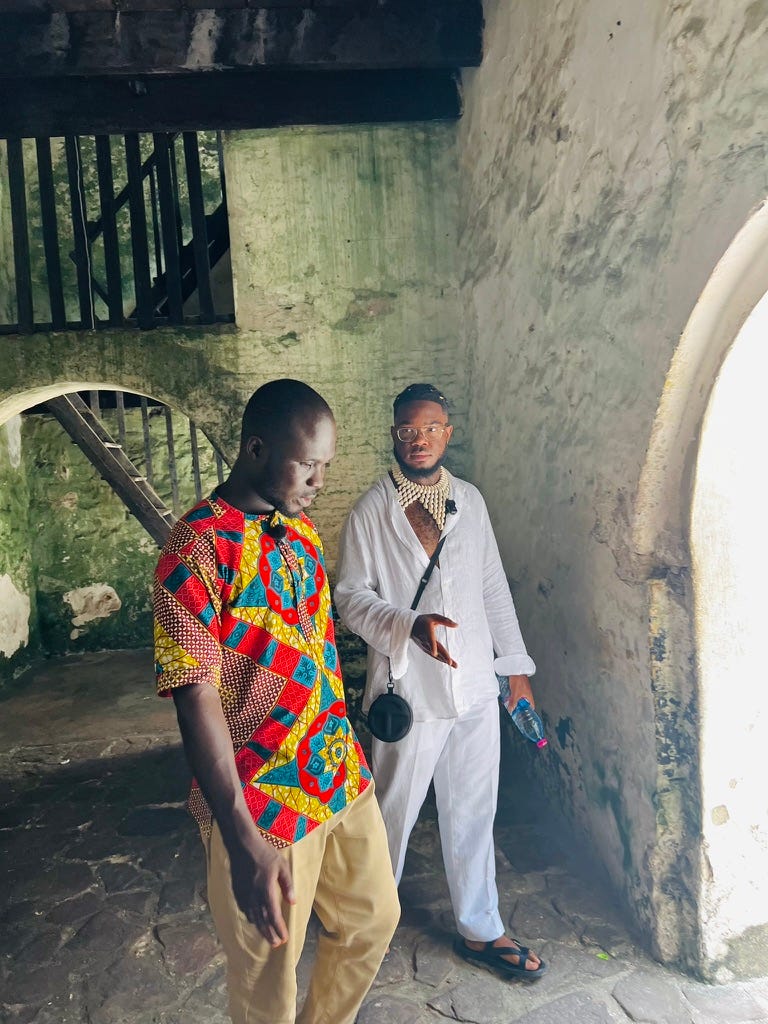
When my flight landed at Kotoka International Airport, tears streamed down my face. At the time, I didn’t understand why. Now I do. My soul was being freed—freed from mental shackles, from covert systems that redlined neighborhoods and denied Black people access to homeownership. I was a free Black man in the land of Blackness, and suddenly everything felt possible.
In Ghana, I felt spiritually aligned. Everyone I met, everything I did, carried meaning. Throughout the trip, I experienced constant déjà vu—as if I had been there before. When I met with a traditional sightseer, the room grew cold. I felt my ancestors calling. Those moments anchored me spiritually and ancestrally.
Africa taught me what it truly meant to be free. It was the unruly body hair, the casual tardiness, dancing with women in the street, joking with vendors, laughing without restraint. My sense of self became whole. For the first time, I saw myself through a Black beauty standard—and I was handsome. Desired. At ease.
Grounding vs. Range
Africa gave me grounding and reclamation.
London, in contrast, gave me range.
London became a melting pot of Afro-Caribbean cultures—a place to explore the vastness of the diaspora. Walking through Tate Modern, I reflected on what the city’s creative ecosystem offered me. I knew it would be competitive, but what surprised me was its layered intersectionality. London granted access to cultures across the globe, revealing how uniquely African culture connects to others.
I began to understand London as a byproduct of centuries of colonization. I don’t excuse that history—but I acknowledge it. Without it, I wouldn’t be standing in Tate Modern admiring art from Asia, Africa, and the Americas. Without it, London wouldn’t be what it is today. Colonization is complex, ongoing, and unresolved—but I learned to find meaning within the system as it exists.
The Gift of Anonymity
One thing I deeply appreciate about London is its anonymity. Here, I can build quietly. Everyone is chasing their break, which reminds me that I am still human—still part of the masses. That anonymity humbles me and grants me freedom. I can create without intrusion, building my brand silently in broad daylight.
Reimagining Luxury Through Africa
Geographically, London is ideal for building an African-first brand. It sits only hours from Africa, welcomes global tourism, and holds one of the largest diasporic populations. My intention is to carry Africa forward—to show that neither Africa nor the diaspora is confined by geography. Strategically, London places me near global markets while immersing me in cultural fluency.
Hotep Negus is an expression of this vibrancy. I reimagine colonization through an African lens, asking: What if Africa had colonized the world? Victorian-inspired pieces become tools for questioning luxury itself. Through fashion, I explore Black dandyism and narrative reclamation.
The Loneliness of the In-Between
Here’s the part people don’t talk about: never feeling fully claimed by a place is lonely. Africa is my motherland, yet in Ghana I’m often seen as a foreigner—sometimes even exploited. In America, I’m too Black. I exist between worlds.
Living in the “in-between” requires peace with your identity, choices, and soul. Others won’t always understand the baggage of a wandering spirit. That’s why I urge people to research deeply and build community wherever they land.
Learning to Live in Transition
Being in transition has sharpened my intuition. Without noise, I move with clarity. I listen to my body, my mind, my spirit. I know when it’s time to move again.
Let’s be clear: London doesn’t replace Africa or America. It integrates them. It keeps me connected to Western systems while anchoring me within the Afro-Caribbean diaspora.
Integration, Not Replacement
My creativity thrives where multiplicity exists. Without it, I wither. My soul lives in the desert and the sky. I am one with the Earth. That is the essence of living in-between.
Spatiality doesn’t define you.
It connects you to who you’ve always been becoming.